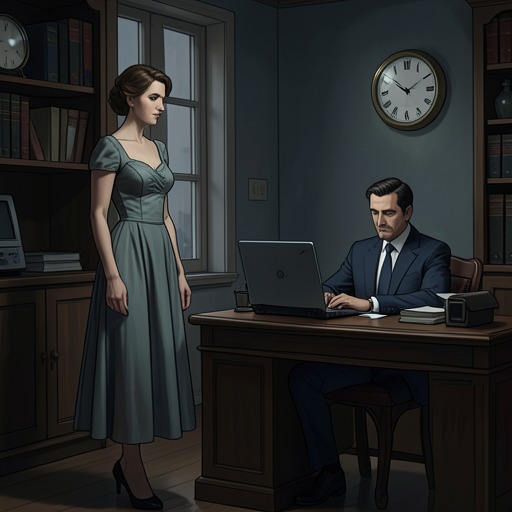
Auden challenges her father to try again for the family
Along for the RideAuden challenges her father to try again for the family when a phone call about his possible return home becomes a confrontation over who should take the next step. She rejects his declaration of love as insufficient on its own: if he wants to be with Heidi and Thisbe, he must prove it. The exchange also reveals why the family’s future weighs on Auden so heavily: she sees her father’s withdrawal not only as a failure toward her, but as a choice that could shape the life of a child just beginning hers.
The Call and the Distance Between Them
The conversation begins in strained quiet. Auden’s father says he has left messages and assumes she is angry; she tells him she has been working things out. He knows that she is with Heidi and hearing her perspective. Then he gives Auden the essential news: Heidi wants him to come home. He says he wants that too, but insists that it is not simple. His qualification leaves the crucial question unanswered—what, exactly, is stopping him from returning?
Auden continues moving the dresses in her closet while they speak. The hangers clack as she pushes past a purple dress and a run of colors, then through black and green garments. The small, repetitive action gives the conversation a physical rhythm: while her father hesitates, she keeps moving through the choices in front of her. Against this backdrop, she tells him that he has an opportunity for a second chance, but would rather quit. The accusation is not simply that he has disappointed her; it is that he is choosing not to attempt repair when an attempt remains possible.
Naming the Stakes
Her father asks whether she thinks he is quitting on her. Auden answers that she does not mean herself. Asked whom she does mean, she recognizes the answer while looking at a simple black dress decorated with tiny beads. The answer is Thisbe. The dress becomes, in the scene’s structure, the moment when an argument that had seemed to concern Auden and her father alone widens into a question about the whole family.
Auden recalls Thisbe in contrasting states: squawking, cooing, wailing, and drooling; asleep, wakeful, fussy, or content. She remembers first seeing the baby asleep in Heidi’s arms and, shortly before the call, seeing Thisbe follow her with her eyes as she left the room. Those ordinary details make the stakes concrete. Thisbe is not an abstract reason for reconciliation but a person at the very beginning of her life, with nearly everything still ahead of her. Auden hopes she will not need many second chances and might get things right the first time—a hope that sits uneasily beside the older characters’ failures and the struggle to try again.
Love, Proof, and Unequal Effort
Auden’s father says that he loves Thisbe and Auden and would do anything in the world for either of them. Auden has heard a similar assurance from Auden’s mother moments earlier and has chosen to believe it. Yet the two declarations do not feel equally persuasive to her. Auden’s mother has come to her, traveled to reach her, and retraced some or all of her steps in an effort to find a way forward. Her father, Auden thinks, remains in the same place and again expects Auden to come to him.
That comparison gives Auden’s challenge its sharper meaning. She remembers repeatedly crossing the distance between them, crossing town, accommodating him, and making excuses. She does not deny that he loves her; she asks him to make love legible through what he does. When he asks how he is supposed to prove it, she refuses to supply a plan. He must figure it out. The response leaves responsibility with him instead of turning Auden’s demand into another task she must carry on his behalf.
From the Challenge to the Bicycle
After telling her father that there is something she has to do, Auden takes the black beaded dress from the closet and lays it across the bed. She had intended to drive and has her keys in hand as she leaves. Then she sees Auden’s bicycle by the steps. Recalling the possibility that a third attempt might be the charm, she describes herself as a quitter too and recognizes that she will never know unless she gets back on the bicycle one last time.
She climbs on, tries to remember what Maggie has taught her over the preceding weeks, and pushes off before she can change her mind. She wobbles down the front walk but remains upright. The movement does not resolve her father’s decision; the evidence of the scene ends with her setting out on her own attempt. But it gives the challenge a practical counterpart: Auden asks her father to risk trying again while taking that risk herself. Her ride makes the conversation more than an appeal for reconciliation. It marks a shift from waiting for other people to change toward acting despite the possibility of failure.